
344.2K
Downloads
654
Episodes
Safety Culture Excellence is a weekly series designed to support your efforts towards excellence in performance and culture. For more information or to contact the host, visit www.ProActSafety.com.
Episodes
Wednesday Jul 23, 2014
Wednesday Jul 23, 2014
Today’s economic realities have necessitated a great deal of outsourcing. Organizations are clinging to their core competencies and value potential and hiring out peripheral tasks. In safety, more and more of the training function is being outsourced. This can be a good approach to some types of safety training but is definitely not for others.
Definite YES: Skills training by technical experts is almost always more effective. If the organization cannot justify keeping such an expert onboard full-time, outsourcing makes good sense and is often quite effective.
Definite NO: Training that establishes official management style or organizational philosophy. If you want your supervisors to coach safety or your leaders to stay on message about organizational mission and vision for safety, outside trainers are definitely not the way. Specific skills such as coaching or communications can be taught by outsiders, but the deep-rooted organizationally-specific style training is best done by an insider with recognized ties to the organization and specific information to answer questions on strategy and tactics.
Maybe with Qualifications: Training that is required for regulatory compliance can often be outsourced effectively. The one nuance is that much of this type of training is very generic and may not be easily or directly applied by workers to their specific tasks. Training that is too theoretical may lose its effectiveness if the link between the theory and workplace reality is not clear.
Outsourcing the right training and keeping the right training in-house can be a key to success in safety.
-Terry L. Mathis
For more insights, visit www.ProActSafety.com
Terry L. Mathis is the founder and CEO of ProAct Safety, an international safety and performance excellence firm. He is known for his dynamic presentations in the fields of behavioral and cultural safety, leadership, and operational performance, and is a regular speaker at ASSE, NSC, and numerous company and industry conferences. EHS Today listed Terry as a Safety Guru in ‘The 50 People Who Most Influenced EHS in 2010, 2011 and 2012-2013. He has been a frequent contributor to industry magazines for over 15 years and is the coauthor of STEPS to Safety Culture Excellence, 2013, WILEY.
Wednesday Jul 16, 2014
Wednesday Jul 16, 2014
Some of the old safety programs and processes are still alive and well in certain organizations. When I examine how they have survived so long I almost always find that the program has been modified and customized. The organization is not still doing the process like they were taught, they have “made it their own” over the years using the basic concept(s) but modifying the details.
Another term for customizing might be “culturizing.” When a group of people not only use a methodology but modify it to fit their specific needs and standards, it truly becomes a part of the organizational culture. It is no longer solely the brainchild of the originator, but the adopted child of the group. As it permeates the group it becomes a part of the culture that is shared and handed down.
Such processes never become outdated because they are fluid and the group can evolve them to meet changing needs and challenges. Perhaps it should be the goal of every safety program or process to have this kind of flexibility built in as a sustainability tool. If this were the case, there would likely be fewer flavors of the month and more tools to build strong safety cultures.
-Terry L. Mathis
For more insights, visit www.ProActSafety.com
Terry L. Mathis is the founder and CEO of ProAct Safety, an international safety and performance excellence firm. He is known for his dynamic presentations in the fields of behavioral and cultural safety, leadership, and operational performance, and is a regular speaker at ASSE, NSC, and numerous company and industry conferences. EHS Today listed Terry as a Safety Guru in ‘The 50 People Who Most Influenced EHS in 2010, 2011 and 2012-2013. He has been a frequent contributor to industry magazines for over 15 years and is the coauthor of STEPS to Safety Culture Excellence, 2013, WILEY.
Wednesday Jul 09, 2014
Wednesday Jul 09, 2014
Forget the old ways of measuring safety culture maturity. There is a new, more effective way to measure cultural maturity and it starts with looking at the chemistry.
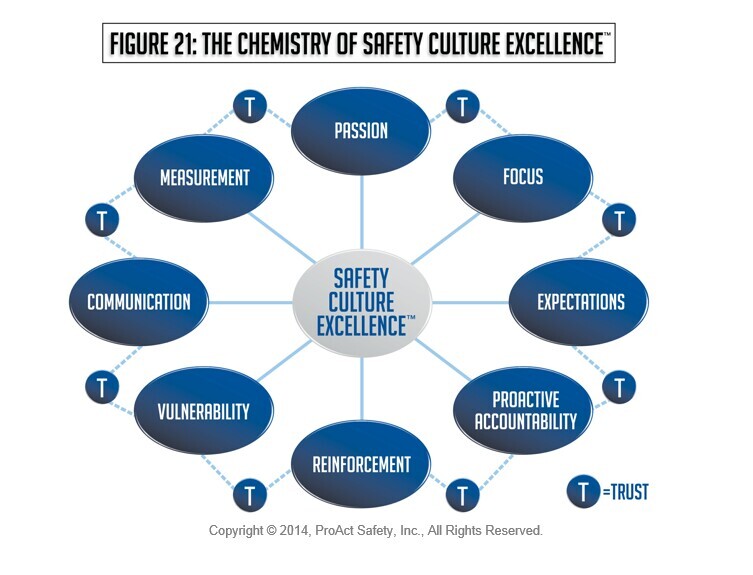
In consulting globally with many of the best in safety performance and culture, nine elements (see the picture with this post) have been identified as most important foci to establish the chemistry which facilitates the necessary climate for a culture of safety excellence to grow. Through consulting engagements and workshops, these nine elements have been successfully leveraged and measured to help organizations identify both their starting point baseline, and also to strategically prioritize which elements to focus on to advance the capabilities of their safety culture.
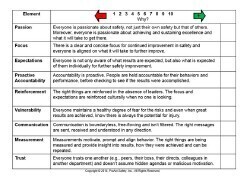
If you have read my work, participated in any of my workshops or keynote presentations or worked with me directly, you will know I work hard to always provide more take-away tools than motivational fluff. If I was able to provide the framework to facilitate the internal dialogue in article format, I would.
To assist you on your journey to safety excellence, I would like to share this tool with you. To obtain a copy for your internal use, send an email to info@proactsafety.com with the subject of Please Send Chemistry of SCE and our staff will respond at our earliest opportunity.
Cultures will always influence the beliefs and behaviors of employees and contractors as they join the group. You can either manage the chemistry, climate and culture, or the results in any area of operational performance will be managed by them. I invite you to start the conversation to strategically enhance the safety aspect of your company culture and measure your progress by contributed value, not just the lowering of injury rates.
-------------------
Shawn M. Galloway is the President and COO of ProAct Safety. He writes (and tweets:@safetyculture) about his work helping organizations in all industries to achieve and sustain excellence in their culture and performance. He resides near Houston, Texas with his wife and three children.
Wednesday Jul 02, 2014
Wednesday Jul 02, 2014
A controversy has almost always attracted attention. That is why some constantly try to provoke an argument about some aspect of a practice. The idea of questioning the status quo is a legitimate issue, but simply challenging the establishment does not advance the cause. True advancement comes from trying the new, not from simply attacking the old.
There is a parallel between the provocateur and the old dichotomous thinking expressed in the saying, “If it ain’t broke don’t fix it!” The idea that everything fits into either the fixed or broken category is limited, two-dimensional thinking at best. The innovative approach does not categorize ideas or practices, but seeks to advance them. In true innovation, there are not even “best practices” because such thinking might stop future progress. There are better practices that will be replaced by even better practices as our wits sharpen and our organizations embrace transformational thinking.
Blue ocean thinking opens whole new avenues of opportunity for the landlocked. Provocation tends to bomb the island on which we live without discovering a new one.
-Terry L. Mathis
For more insights, visit www.ProActSafety.com
Terry L. Mathis is the founder and CEO of ProAct Safety, an international safety and performance excellence firm. He is known for his dynamic presentations in the fields of behavioral and cultural safety, leadership, and operational performance, and is a regular speaker at ASSE, NSC, and numerous company and industry conferences. EHS Today listed Terry as a Safety Guru in ‘The 50 People Who Most Influenced EHS in 2010, 2011 and 2012-2013. He has been a frequent contributor to industry magazines for over 15 years and is the coauthor of STEPS to Safety Culture Excellence, 2013, WILEY.
Wednesday Jun 25, 2014
Wednesday Jun 25, 2014
If you define production as products or services delivered and do not include safety in that definition, you are creating a dichotomy that will damage both production and safety. Production that injures those who produce it is most likely not the kind of production your organization wants. An accident (incident, injury – pick your preferred term) is a defect in your production process just as surely as a quality issue. If you develop a tolerance for poor quality or poor safety, you have developed a tolerance for poor production.
Organizations who achieve safety excellence do not make this distinction. They define production as safe and high quality products or services delivered. They manage safety and quality as a part of production rather than separate priorities. Workers who compromise any aspect of safety or quality have compromised production. The old ideas of production at any cost and sacrificing your body for the team are antiquated and counterproductive. If you still have these dichotomies in your organization, begin to improve by redefining what production is and what you expect from production workers.
-Terry L. Mathis
For more insights, visit www.ProActSafety.com
Terry L. Mathis is the founder and CEO of ProAct Safety, an international safety and performance excellence firm. He is known for his dynamic presentations in the fields of behavioral and cultural safety, leadership, and operational performance, and is a regular speaker at ASSE, NSC, and numerous company and industry conferences. EHS Today listed Terry as a Safety Guru in ‘The 50 People Who Most Influenced EHS in 2010, 2011 and 2012-2013. He has been a frequent contributor to industry magazines for over 15 years and is the coauthor of STEPS to Safety Culture Excellence, 2013, WILEY.
Wednesday Jun 18, 2014
Wednesday Jun 18, 2014
The medical profession is concerned that the overuse of antibiotics is causing strains of bacteria to become resistant and patients to be less receptive to the most-used medications. The same thing can happen to safety when training is overused or misused. Workers can tune it out and workplace accidents can become resistant to it.
Regulatory mandates require a quantity and content of safety training, but more or less neglect the quality of that training. This has resulted in some of the dullest, most monotonous and least-effective safety training that the world has ever seen. The use of Computer-Based Training (CBT) has further aggravated the problem. Required safety training in many organizations is viewed at best as a necessary evil by any worker who has taken it more than two times. When safety training quits being an asset to the organization, it can damage the effectiveness of other safety-improvement efforts as well.
If this state of safety training were not bad enough, some organizations actually use training or re-training as a punishment. When a worker is injured or is caught failing to follow a safety rule, they can be sent back to training. The assumption that the training did not impact worker behavior is valid enough, but the assumption that more of the same, ineffective training will magically work the second time is borderline absurd. Also, if safety re-training is viewed as a form of punishment, how will that impact the overall perception of the value of safety training?
Organizations need to view safety training as a tool to meet worker needs rather than a painful requirement that can be re-used as punishment. The opportunities for good quality safety to improve safety performance has been demonstrated. It is time to use it to its full potential instead of going through the motions!
-Terry L. Mathis
For more insights, visit www.ProActSafety.com
Terry L. Mathis is the founder and CEO of ProAct Safety, an international safety and performance excellence firm. He is known for his dynamic presentations in the fields of behavioral and cultural safety, leadership, and operational performance, and is a regular speaker at ASSE, NSC, and numerous company and industry conferences. EHS Today listed Terry as a Safety Guru in ‘The 50 People Who Most Influenced EHS in 2010, 2011 and 2012-2013. He has been a frequent contributor to industry magazines for over 15 years and is the coauthor of STEPS to Safety Culture Excellence, 2013, WILEY.
Wednesday Jun 11, 2014
Wednesday Jun 11, 2014
A famous business leader once said there are two kinds of people in business: those who make results and those who make excuses. He called these first types of people, “results-oriented.” I would like to suggest another type. These are people who very much seek results and do not accept excuses but care deeply how those results are created. They care about the “how” for two reasons: 1. They want to create ability in their organization as well as results and 2. They want to deeply understand how results are created and how to repeat them. I call these people “excellence-oriented.”
Excellence-oriented is a step above results-oriented. It is based on longer-term thinking and the seeking of what Deming called “profound knowledge.” Excellent results can be the product of luck in the short term and excellence-oriented people understand this. That is why “zero accidents” or “zero defects” can only be goal and not a strategy for them. They understand that excellence is more than a flash in the pan or five minutes of glory. Excellence is the ability to control results over the long term and this ability is one of the most valuable commodities an organization can have in this age of global competition.
-Terry L. Mathis
For more insights, visit www.ProActSafety.com
Terry L. Mathis is the founder and CEO of ProAct Safety, an international safety and performance excellence firm. He is known for his dynamic presentations in the fields of behavioral and cultural safety, leadership, and operational performance, and is a regular speaker at ASSE, NSC, and numerous company and industry conferences. EHS Today listed Terry as a Safety Guru in ‘The 50 People Who Most Influenced EHS in 2010, 2011 and 2012-2013. He has been a frequent contributor to industry magazines for over 15 years and is the coauthor of STEPS to Safety Culture Excellence, 2013, WILEY.
Wednesday Jun 04, 2014
Wednesday Jun 04, 2014
The leaders of an organization who were asking for my help to improve their safety efforts told me that they were all pushing safety as hard as they could. I asked them who was driving safety and how long it had been stalled and needing to be pushed. Almost every leadership team is either neglecting, pushing or driving safety. Neglect brings on disaster. The need for pushing often results from previous neglect. Driving safety almost always results in progress and improvement.
Just as the term implies, driving is giving direction, speed and stability to the safety effort. Stalled efforts may require some pushing, but well-running efforts simply need drivers. The most recognized drivers of safety are leadership, supervision, guidelines, and training. Leaders need to give safety strategic direction. Supervisors need to steer and correct the daily efforts. Guidelines, such as rules, procedures, and P.P.E. requirements should provide a road map for the workplace decisions that impact safety. Training should ensure that everyone knows the guidelines and can also recognize and manage the risks in the workplace that may not be fully covered by the guidelines.
Safety efforts that are strategically driven shape the perceptions and culture of the safety efforts. The perceptions and culture combine with the training to shape the daily performance. Supervision keeps the daily performance on track. The daily performance produces the results that are measured by the lagging indicators of safety. If your lagging indicators indicate you are not at your desired destination, ask yourself “who is driving?”
-Terry L. Mathis
For more insights, visit www.ProActSafety.com
Terry L. Mathis is the founder and CEO of ProAct Safety, an international safety and performance excellence firm. He is known for his dynamic presentations in the fields of behavioral and cultural safety, leadership, and operational performance, and is a regular speaker at ASSE, NSC, and numerous company and industry conferences. EHS Today listed Terry as a Safety Guru in ‘The 50 People Who Most Influenced EHS in 2010, 2011 and 2012-2013. He has been a frequent contributor to industry magazines for over 15 years and is the coauthor of STEPS to Safety Culture Excellence, 2013, WILEY.
Wednesday May 28, 2014
Wednesday May 28, 2014
The only problem with a successful safety effort is success. Success can seriously damage the organizational and individual sense of vulnerability necessary for future success. When no accidents happen for a long enough period of time, people can drop their guard. Celebrations of success that don’t include admonishments for renewed effort can lead to workers who are too busy patting themselves on the back to be safe. The age old, “it isn’t going to happen to me” mentality begins to grow and minds start to think their bodies are bulletproof.
Some of the best-performing organizations in safety are the ones where workers come to work each day with a full realization that accidents are possible and waiting. No one lowers their guard because they know the dangers are still there. There is a healthy respect for the possibility of a tragedy and everyone is standing guard to prevent it.
Vulnerability need not reach the panic level, but also cannot be allowed to go completely away, even for moments. Just like disease, accidents are best addressed through early detection and management of risk factors; not through reactive measures to control the damage. Can your organization celebrate success without losing its healthy sense of vulnerability?
-Terry L. Mathis
For more insights, visit www.ProActSafety.com
Terry L. Mathis is the founder and CEO of ProAct Safety, an international safety and performance excellence firm. He is known for his dynamic presentations in the fields of behavioral and cultural safety, leadership, and operational performance, and is a regular speaker at ASSE, NSC, and numerous company and industry conferences. EHS Today listed Terry as a Safety Guru in ‘The 50 People Who Most Influenced EHS in 2010, 2011 and 2012-2013. He has been a frequent contributor to industry magazines for over 15 years and is the coauthor of STEPS to Safety Culture Excellence, 2013, WILEY.
Wednesday May 21, 2014
Wednesday May 21, 2014
Anything that becomes too routine quits grabbing our attention. If we follow routines we can form habits and make certain behaviors more or less automatic, but appealing to the automatic does not trigger further improvement. So what happens when safety meetings and safety communication become too routine? Workers tend to tune them out and go about their business. Safety doesn’t necessarily get any worse, but it also does not get better.
Almost every organization either sets goals, starts new initiatives, or just wishes real hard to make safety results better this year than last year. But the same old routine will not make it happen. All safety meetings and communication should avoid routine like the plague. Everything about safety needs to be focused on improvement targets and reporting progress toward goals. Even accident reports should be compared and contrasted to targeted improvements to align effort with desired results.
When safety is current and meaningful, the same old same old disappears and bright targets take its place. Workers see the light at the end of the tunnel and develop a sense of direction. Progress motivates more progress and true improvement becomes possible.
-Terry L. Mathis
For more insights, visit www.ProActSafety.com
Terry L. Mathis is the founder and CEO of ProAct Safety, an international safety and performance excellence firm. He is known for his dynamic presentations in the fields of behavioral and cultural safety, leadership, and operational performance, and is a regular speaker at ASSE, NSC, and numerous company and industry conferences. EHS Today listed Terry as a Safety Guru in ‘The 50 People Who Most Influenced EHS in 2010, 2011 and 2012-2013. He has been a frequent contributor to industry magazines for over 15 years and is the coauthor of STEPS to Safety Culture Excellence, 2013, WILEY.